This week's problem strips the climbing experience down to its bare bones-
its essence! This problem is very much like a three chord Ramones tune: clean,
efficient, minimal, in your face, aggressive and purposeful. If climbing could be
boiled down, reduced to one move, this move is the one I would choose; it is
punchy and delicate in equal measure, fustrating when close, amazing when sent.
No other problem on Pisa wall demands dynamism of this quality. The Seven foot
dyno might be bigger, but this problem is definitly better; it requires the would-be ascentionist to float rather than fly!
The Pex Dyno V7.
I could be minimal in my description of this problem, it is a one move dyno
or deadpoint after all, however this would rob you of the essential beta which
drags this problem into the realm of reality. Firstly locate hold 18 - it is a
long shallow crimp. The surface of this hold is rather uniform save for a small
rough dimple found slightly left of centre, the pad of the index finger on you
left hand needs to nestle in this depression. Once orientated, both hands need to
crimp hold 18; don't expect to generate a lot of power from your hands on this
problem- body position is key. Now that your hands are set, put your left foot in
a lowish dimple directly below your hands. The right foot is placed square to
the wall on a prominent dimple up and right. Now it is time for flight; movement
will be initiated from the left foot, this will swing your centre of gravity up
and over your right foot, this allows you to spring off the right foot and float
up to the break. Match and enjoy. This move is all about timing; it works like
a rock over, it looks like a dyno, but if you get it right, it feels like magic!
Pex Dyno V7 from Owen McShane on Vimeo.
Saturday, 20 April 2013

Wednesday, 10 April 2013
Feel the lick of the Leviathan.
 |
| There be sea monsters down there at Borth |
In Ellsemere Port over Easter bank holiday weekend they have an international sea shanty festival. I found out about it immediately after the event this year. The sense of disappointment I felt at missing this jamboree was crushing. Unbeknownst to the festival organisers I had grown a fisherman's beard and would have walked tall in this world of facial hair and cable-knit jumpers; a wasted opportunity for which a warm chin in cold weather was no real comfort or consolation. The briny, barnacled world of sea shanties fascinates me: old men in canvas coats and flat caps smoking porcelain pipes, creating close harmonies of times under the sail, stars and moon. This subculture still has a faint whiff of piracy about it, not the type that infringes copyright, rather the dastardly variety that reeks of daring deeds and rum. It's odd that Ellsmere holds this festival. Even with its estuarine position and industrial jetties the town seems divorced from the sea, held hostage by the motorway that now bisects it and provides its life blood.
 |
| Now that's what I call a sea shanty beard. |
Shanties and songs of the sea were used to motivate and coordinate repetitive tasks undertaken by those who lived under the sail. The Chantyman would lead: he would call the line and the crew would echo his words as they heaved the sail or raised the anchor. In this way tales would be told, and the histories of those who existed in the space suspended between sea and soil would take on their own forms. Stories developed their own energy and life, twisting and evolving into fantastical shapes as they voyaged around the globe and through time, propelled by the winds of adventure. The Chantyman called the line with promises of beasts, battles and booty; the young and strong followed his call to the shore and beyond!
Stories of monsters have always drifted across the seas: The Cracken, The Leviathan, sea serpents and giant whales have fuelled the rhythms of the Chantyman. These beasts have poured fear into the hearts of those on both land and sea, their reputations as fierce as the stories that created them. Legends like these draw out the brave, stupid and strong; young men who set out to sea to make a name for themselves, to fight and become immortalised in the words of the Chantyman.
Whilst my stupidity is well known I am neither brave nor strong, if I chant you a line, will you follow my song?
I spend a lot of my time walking the line between sea and soil finding wave-washed gems to ascend. Ogmore, Ysgo and Dinellain have all been plundered producing tales to motivate others. Songs of slopers and overhangs, barnacles and biceps drift along these shores. Mid Wales has been one of my main muses for some time: Clarach and Borth have both had me echoing their call, hauling me back again and again to see what new tales lie around the corner.
A recent trip across the ancient sands and shales of mid wales revealed a terrifying secret to me, one I will share; what you do with this information is beyond my control. I was trawling the rich coastline at Borth looking for fine, slick slopers of such quality they would drive a boulderer mad. As I assessed the coastline my eyes were drawn to a darkness in the cliff line, something was brooding there in the shadows, something that did not sit well with my conscience. I went to investigate. I did not know what lay there beyond the depths of my perception. What I found filled me with both awe and dread.
 |
| The line between sea and soil |
On that tranquil shore sits a beast, a leviathan of a line- monstrously steep and fantastically frictionless. Washed up by ancient storms it sits there fossilised by time. I approached this slumbering creature with caution, not wanting to wake it. I gazed upon it smooth yet scaly, barrelled belly scarred by single-pad, directional undercuts leading along its length to a change of angle and some actual holds on its head wall. Tension, strength, patience and persistence would all need to be used in equal measure to tame this animal born in the depths; if we add a less than perfect landing into this equation we are looking at an endeavour that legends are made of! Overcome by fear I turned and ran, knowing that I'm too weak of heart, mind and muscle to go even one round with this beast. I ran knowing that I was lucky to live to tell this tale; this line could consume you, devour your climbing career by placing you in a world of pain with years of fruitless sessions that would strip a man like me of strength, psyche and sanity.
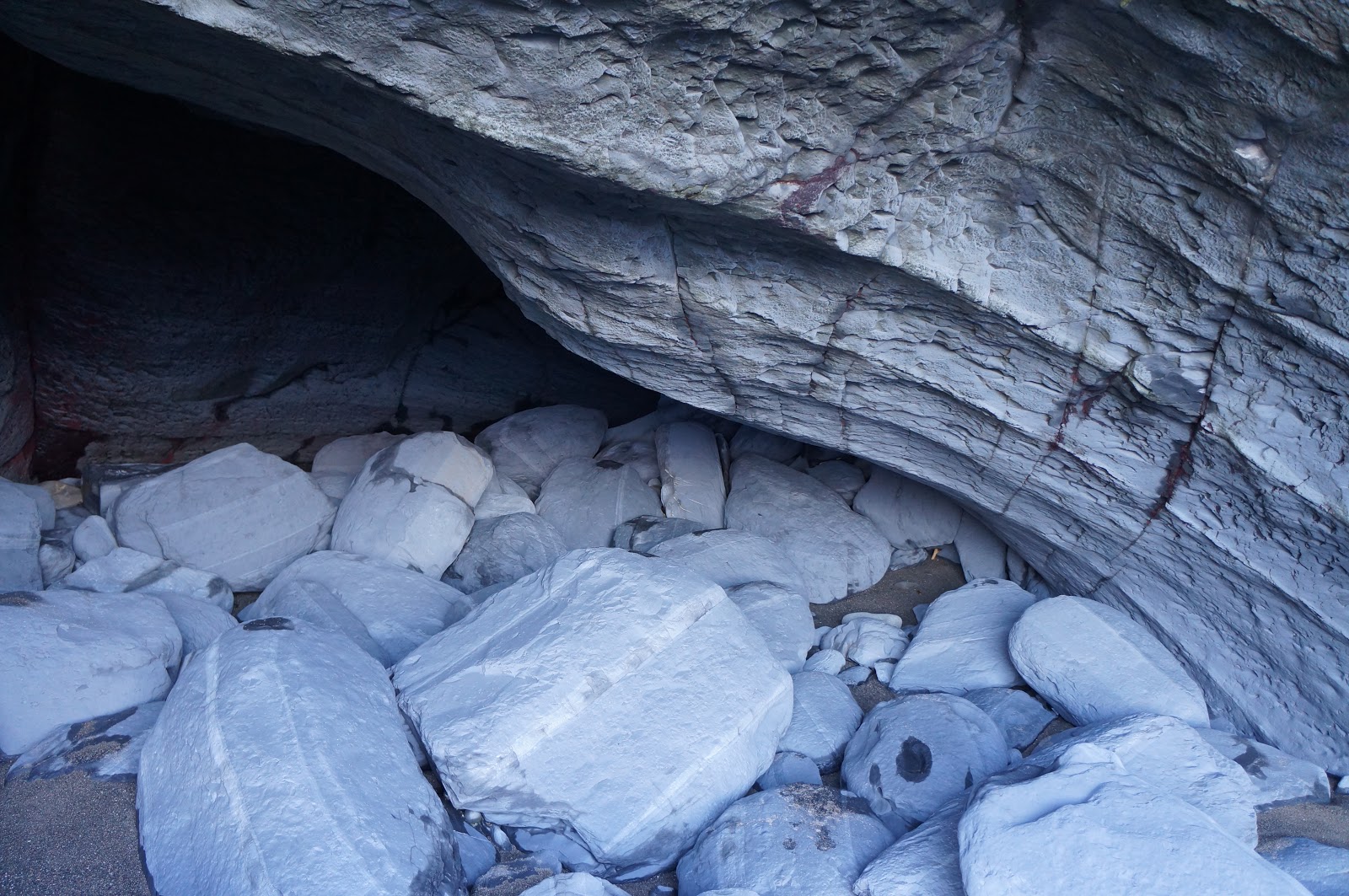 |
| The belly of the beast. |


 |
| Skinny Dog gives you a sense of the scale, the beast is big!! |
You may ask why I chant these lines- who would answer this call? Like an ancient mariner or a tainted trawler man I could just be deluded, lured into fanciful, tall tales by the romance and rhythm of the sea and the ruination of rum. However I have stood beneath many of the titans of Europe: Big Paw, From the Dirt Grows the Flowers, Ill Thrill, Dream Time and the Dagger. Borth's Leviathan could fight them all, go toe to toe, look these other monsters in the eye and know that it belongs in the same storybook. An ascent of the Beast of Borth would be legendary; a hero would be born, a killer line would be tamed and a new story would set sail across the seas creating a life of its own amongst those who toil rhythmically with brush, pad, and chalk.
I plan to go to Ellsmere Port next year at Easter. I want to sit amongst bearded men singing tales of adventure whilst sipping ales and wearing arran. I will listen to Chantymen from around the world painting pictures of a way of life now lost, a life dominated by sail, storms and seas. I would like to chant a song at the festival - tell a tale. My story would reveal a world where sand meets sea, where cliffs and storms collide in a titanic battle that never ends. A battle that creates and destroys in equal measure, a battle from which monsters are born! My story will be filled with a fight between the tides, struggles with slopers, battles with beasts, and the taming of the wild. I will be the Chantyman, will you be the hero?
Friday, 5 April 2013
Pex Problem of the Week #6
Last week we went off-page and explored one of the pisa problems dredged up
from the murky mires of my mind. This week our normal service resumes. There
are individuals who have been waiting for this week's problem for some time; I
make no apologies if I gush slightly in my description as it is one of the
best problems I have done anywhere at any time. So turn to pages 178 and 179 of
the Cheshire and Merseyside Sandstone guide and we will begin:
Vitalite - V6
Vitalite is the jewel in Pisa's crown; yes there are harder problems and yes it is an eliminate, however climbing with three finger stacks does not get better than this. The quality of movement on this problem means that as an entity it transcends its location, environment, and the circumstances of its creation. If it were pure this problem would have stars- lots of them (and I would still want to give it more)! Subtle and frustrating, delicate and powerful, Vitalite has it all. This problem deserves special attention; it should stand proud, pure, the only problem on a huge boulder sitting majestically in an unspoilt landscape. Unfortunately Vitalite calls Pex its home but remains undiminished by that fact.
First you will want to go and fetch a brush from your bag, one with very soft bristles that will clean rather than scrape chalk from the surface of this sandstone. Next find holds 16, 21, and 22 (there is no point committing to this endeavour if it is sullied by excess stale chalk- you won't appreciate the true feel of the rock and upward progress will be hard to achieve). Finally, before you begin to climb, step back, breathe in and know that you are about to try one of the best.
Start by matching hold 3, your right foot should be buried in a low pock mark, your left should be high on hold 1 firmly set square to the wall. Now reach up high with the left to hold 16 (to do this you will need to drop your right shoulder to such an extent that it feels like you're looking at the floor). Hold 16 is a very marginal three finger stack, to lock it you will need to take your right foot out of its low resting place, kick it to a deep flag out to the left, find the point of balance and reach with your right to hold 21. Breathe! You should be holding 21 with a stack and it should feel like a gaston (your right elbow should be high), rock up onto your left foot and hit hold 22 as an opposition stack. Squeeze! Swap feet on hold 1, bury your left foot deep into hold six, again with your heel sitting square to the wall start to rock over. At this point you'll appreciate all the cleaning you have done- you've been holding hold 21 for a long time and now you have to shoulder press off it. Press off the right hand, rock onto the left foot until you reach the break. Match, stop, think... Take some time to savour the moment. Jump down, pack up your things and go home, you won't climb anything better this session!
Vitalite V6 from Owen McShane on Vimeo.
Vitalite - V6
Vitalite is the jewel in Pisa's crown; yes there are harder problems and yes it is an eliminate, however climbing with three finger stacks does not get better than this. The quality of movement on this problem means that as an entity it transcends its location, environment, and the circumstances of its creation. If it were pure this problem would have stars- lots of them (and I would still want to give it more)! Subtle and frustrating, delicate and powerful, Vitalite has it all. This problem deserves special attention; it should stand proud, pure, the only problem on a huge boulder sitting majestically in an unspoilt landscape. Unfortunately Vitalite calls Pex its home but remains undiminished by that fact.
First you will want to go and fetch a brush from your bag, one with very soft bristles that will clean rather than scrape chalk from the surface of this sandstone. Next find holds 16, 21, and 22 (there is no point committing to this endeavour if it is sullied by excess stale chalk- you won't appreciate the true feel of the rock and upward progress will be hard to achieve). Finally, before you begin to climb, step back, breathe in and know that you are about to try one of the best.
Start by matching hold 3, your right foot should be buried in a low pock mark, your left should be high on hold 1 firmly set square to the wall. Now reach up high with the left to hold 16 (to do this you will need to drop your right shoulder to such an extent that it feels like you're looking at the floor). Hold 16 is a very marginal three finger stack, to lock it you will need to take your right foot out of its low resting place, kick it to a deep flag out to the left, find the point of balance and reach with your right to hold 21. Breathe! You should be holding 21 with a stack and it should feel like a gaston (your right elbow should be high), rock up onto your left foot and hit hold 22 as an opposition stack. Squeeze! Swap feet on hold 1, bury your left foot deep into hold six, again with your heel sitting square to the wall start to rock over. At this point you'll appreciate all the cleaning you have done- you've been holding hold 21 for a long time and now you have to shoulder press off it. Press off the right hand, rock onto the left foot until you reach the break. Match, stop, think... Take some time to savour the moment. Jump down, pack up your things and go home, you won't climb anything better this session!
Vitalite V6 from Owen McShane on Vimeo.
Thursday, 28 March 2013
Pex Problem of the Week #5
This week we will deviate from the norm into a world where aspirant ascentionists prowl along the base of Pisa Wall lobster-like, fingers frozen into three finger stacks ready to claw at the wall. The problem described in this post involves a different species of hold which is also commonly found in this habitat; the small crimp.
Small Snick Sit down V5.
This particular problem does not feature in the Pex eliminate section of the Cheshire and Merseyside Sandstone guide (remember you will need the topo on pages 178 and 179) however, whilst off page, this problem is one of the best! Balance, strong fingers and a bit of technique are needed to breathe life into this (at first glance anyway) unlikely creation.
Start sitting with both hands on hold.number 2. The left foot should be in a pock mark down and left, the right on a clean ripple out to the right. Pull up off the floor and move your weight over your left foot. Flick the left hand to hold 13 and take it as a gaston and pull the hold into your shoulder. Next put the right foot into a good high pock mark just down and left of hold 2. Now you're set! Shoulder press off the left hand, rock over onto the right foot, finger press with the right hand to gain height and keep in balance. The right hand needs to get to the mono / small crimp which is hold 38; the only way to get there is to stretch and get over that right foot, the left hand and shoulder need to be strong and they need to press it out. Once you get your right to hold 38 get the left foot up and left onto a good hold and reach up left to the break. Match and jump off with burning fingertips and well worked lats.
Small Snick sit down start V5 from Owen McShane on Vimeo.
Small Snick Sit down V5.
This particular problem does not feature in the Pex eliminate section of the Cheshire and Merseyside Sandstone guide (remember you will need the topo on pages 178 and 179) however, whilst off page, this problem is one of the best! Balance, strong fingers and a bit of technique are needed to breathe life into this (at first glance anyway) unlikely creation.
Start sitting with both hands on hold.number 2. The left foot should be in a pock mark down and left, the right on a clean ripple out to the right. Pull up off the floor and move your weight over your left foot. Flick the left hand to hold 13 and take it as a gaston and pull the hold into your shoulder. Next put the right foot into a good high pock mark just down and left of hold 2. Now you're set! Shoulder press off the left hand, rock over onto the right foot, finger press with the right hand to gain height and keep in balance. The right hand needs to get to the mono / small crimp which is hold 38; the only way to get there is to stretch and get over that right foot, the left hand and shoulder need to be strong and they need to press it out. Once you get your right to hold 38 get the left foot up and left onto a good hold and reach up left to the break. Match and jump off with burning fingertips and well worked lats.
Small Snick sit down start V5 from Owen McShane on Vimeo.
Friday, 22 March 2013
Never Forget Frodsham.
 |
| Views to the Mersey from Woodhouse Hill. |
 |
| Alec climbing through the steepness. |
Frodsham's crags sit on the crest of Woodhouse Hill to the west of town. A steep, wooded path leads you up to a series of buttresses that stretch the length of the bluff. In terms of height these red and ochre sandstone outcrops range from three to eight metres, or in other terms, from bouldering to highballing to suicidal stupidity. The common thread that binds all of Frodshams' buttresses is that they are steep- they overhang, majestically shading those who play here from the worst of the Mersey's weather.
 |
| Ochre rock and hard eliminates up on the hill. |

Frodsham's heyday is far behind it now and, like shipping on the Mersey, the volume of human traffic on the hill has wained. The watery tributary that washes the hills feet once attracted the heavyweights of the shipping world: Blue Funnel, White Star, and Cunard - but these great vessels are long gone, forgotten. The present titans of climbing no longer follow that wooded path up to the buttresses on Woodhouse Hill; however the heroes who developed it can still be seen on a summer's evening swinging through the steepness. Tom Leppert and Martin Boyson are rarely wrong! Frodsham has been good enough for these legends for fifty years now, believe me its good enough for you.
Friday, 15 March 2013
Pex problem of the week #4.
This week's adventures through the numbered holds on pages 178 and 179 of the Cheshire and Merseyside Sandstone guide illustrates that different approaches can lead to the same result when ordering from the eliminate menu.
Silly Boy Direct V5 (Done two ways).
This problem is essentially a harder version of Silly Boy V4, however it is amazing how removing one key ingredient can change the flavour and overall feel of a problem: in this case removing hold 38 (a small crimpy mono) turns Silly Boy into a far more robust dish.
Two main methods can be used on this problem; these methods will appeal to very different palates. The first is the way I originally climbed Silly Boy- it is a brash, flash-fried affair, fleeting, fresh and bursting with big flavours. The second is a slower, more controlled dish that allows flavour to mingle, develop and yet still allows a bit a spice to come through at the end. This second method is my preferred preparation for this problem; it is subtle, delivering a more rounded, fuller experience of the Pex eliminate!
Method 1 - The Dyno.
Start matched on hold 7 with feet in low pock marks, move the right hand up to a three finger stack in hold 21, put the left foot up on hold 1 for balance and move the left hand to a stack in hold 20. Now place the right food high on the ledge next to hold 3, lean your body weight to the right so it almost feels like you're laybacking the hand holds, dip down once and dyno to the break.
Boy Direct V5 (method 1) from Owen McShane on Vimeo.
Method 2 - The Rock Over.
As for method 1 however, once you've gained the stacks in holds 20 and 21, swap feet on hold 1, lean to the right and place your left foot deep into hold 6 making sure it is square to the wall. Now slowly move your weight over to the left until you have gained as much height as you can. You'll end up short but a small pop to the jug in the break will release the complex flavours you've been seeking.
Silly Boy Direct V5 (method 2) from Owen McShane on Vimeo.
So there you have it, slow cooked and complex, or flash fried and fresh! When it comes to Pex eliminates you really can indulge yourself with the dishes that suit your particular tastes.
Silly Boy Direct V5 (Done two ways).
This problem is essentially a harder version of Silly Boy V4, however it is amazing how removing one key ingredient can change the flavour and overall feel of a problem: in this case removing hold 38 (a small crimpy mono) turns Silly Boy into a far more robust dish.
Two main methods can be used on this problem; these methods will appeal to very different palates. The first is the way I originally climbed Silly Boy- it is a brash, flash-fried affair, fleeting, fresh and bursting with big flavours. The second is a slower, more controlled dish that allows flavour to mingle, develop and yet still allows a bit a spice to come through at the end. This second method is my preferred preparation for this problem; it is subtle, delivering a more rounded, fuller experience of the Pex eliminate!
Method 1 - The Dyno.
Start matched on hold 7 with feet in low pock marks, move the right hand up to a three finger stack in hold 21, put the left foot up on hold 1 for balance and move the left hand to a stack in hold 20. Now place the right food high on the ledge next to hold 3, lean your body weight to the right so it almost feels like you're laybacking the hand holds, dip down once and dyno to the break.
Boy Direct V5 (method 1) from Owen McShane on Vimeo.
Method 2 - The Rock Over.
As for method 1 however, once you've gained the stacks in holds 20 and 21, swap feet on hold 1, lean to the right and place your left foot deep into hold 6 making sure it is square to the wall. Now slowly move your weight over to the left until you have gained as much height as you can. You'll end up short but a small pop to the jug in the break will release the complex flavours you've been seeking.
Silly Boy Direct V5 (method 2) from Owen McShane on Vimeo.
So there you have it, slow cooked and complex, or flash fried and fresh! When it comes to Pex eliminates you really can indulge yourself with the dishes that suit your particular tastes.
Friday, 8 March 2013
Pex Problem of the week #3
Remember the Pex eliminate topo which nestles inside the New Cheshire and Merseyside Sandstone guide is needed to make sense of this post
Red Flash - V5.
For me this is one of the quintessential problems of Pisa wall; it is what slightly overhanging walls with big holds were invented for - flight (dynos to you and me!). Red Flash is used as a staging post for many on their journey along the sinuous path that leads to the Seven Foot Dyno which also inhabits this section of wall, however it can stand on its own as a dyno of merit and quality.

This week's problem gained its name from a legendary vehicle that taxied Liverpool's bouldering scene around the motorways of the UK in the mid naughties. Red was a feisty 1.4 Astra that could accommodate five willing (or at times unwilling) passengers, their pads, their kit and their psyche! This vehicle was a veritable tardis whose mystical qualities extended to its acoustic abilities; if you wound the front windows down an inch and cranked the Jungle up, it metamorphosised into a living, breathing bass cannon; an organic speaker unit of which you were an integral component. Flash would often be spotted undertaking in the slow lane at breakneck speeds, those interred on the back seat holding up handwritten notes for other motorists. "Help me I've been Kidnapped" would regularly be read by those who actually adhere to the highway code. Flash blew up twice whilst out on duty serving the climbing needs of Merseyside's bouldering lieutenants. He is missed by many- brave in the face of adversity, decorated for deeds beyond the means of his motorised peers. I will apologise now if this eulogy has opened old wounds for some- Flash is gone, but not forgotten!
Right, back to the problem. This one is obviously hard to describe but I will try my utmost to get you through its complex technical moves as efficiently as I can. Take hold 6 with the left hand and hold 7 with the right, put your left foot in a pock mark and put you right foot high on hold 1. From this position sway down once and leap to the next break with the right, on the way up stay close to the wall, then it's a matter of latch, match, and dispatch.
Red Flash V5 from Owen McShane on Vimeo.
For me this is one of the quintessential problems of Pisa wall; it is what slightly overhanging walls with big holds were invented for - flight (dynos to you and me!). Red Flash is used as a staging post for many on their journey along the sinuous path that leads to the Seven Foot Dyno which also inhabits this section of wall, however it can stand on its own as a dyno of merit and quality.
This week's problem gained its name from a legendary vehicle that taxied Liverpool's bouldering scene around the motorways of the UK in the mid naughties. Red was a feisty 1.4 Astra that could accommodate five willing (or at times unwilling) passengers, their pads, their kit and their psyche! This vehicle was a veritable tardis whose mystical qualities extended to its acoustic abilities; if you wound the front windows down an inch and cranked the Jungle up, it metamorphosised into a living, breathing bass cannon; an organic speaker unit of which you were an integral component. Flash would often be spotted undertaking in the slow lane at breakneck speeds, those interred on the back seat holding up handwritten notes for other motorists. "Help me I've been Kidnapped" would regularly be read by those who actually adhere to the highway code. Flash blew up twice whilst out on duty serving the climbing needs of Merseyside's bouldering lieutenants. He is missed by many- brave in the face of adversity, decorated for deeds beyond the means of his motorised peers. I will apologise now if this eulogy has opened old wounds for some- Flash is gone, but not forgotten!
Right, back to the problem. This one is obviously hard to describe but I will try my utmost to get you through its complex technical moves as efficiently as I can. Take hold 6 with the left hand and hold 7 with the right, put your left foot in a pock mark and put you right foot high on hold 1. From this position sway down once and leap to the next break with the right, on the way up stay close to the wall, then it's a matter of latch, match, and dispatch.
Red Flash V5 from Owen McShane on Vimeo.
Subscribe to:
Posts (Atom)