Wednesday, 29 May 2013

The Alchemist

Fatneck on the hunt for quality at Parbold
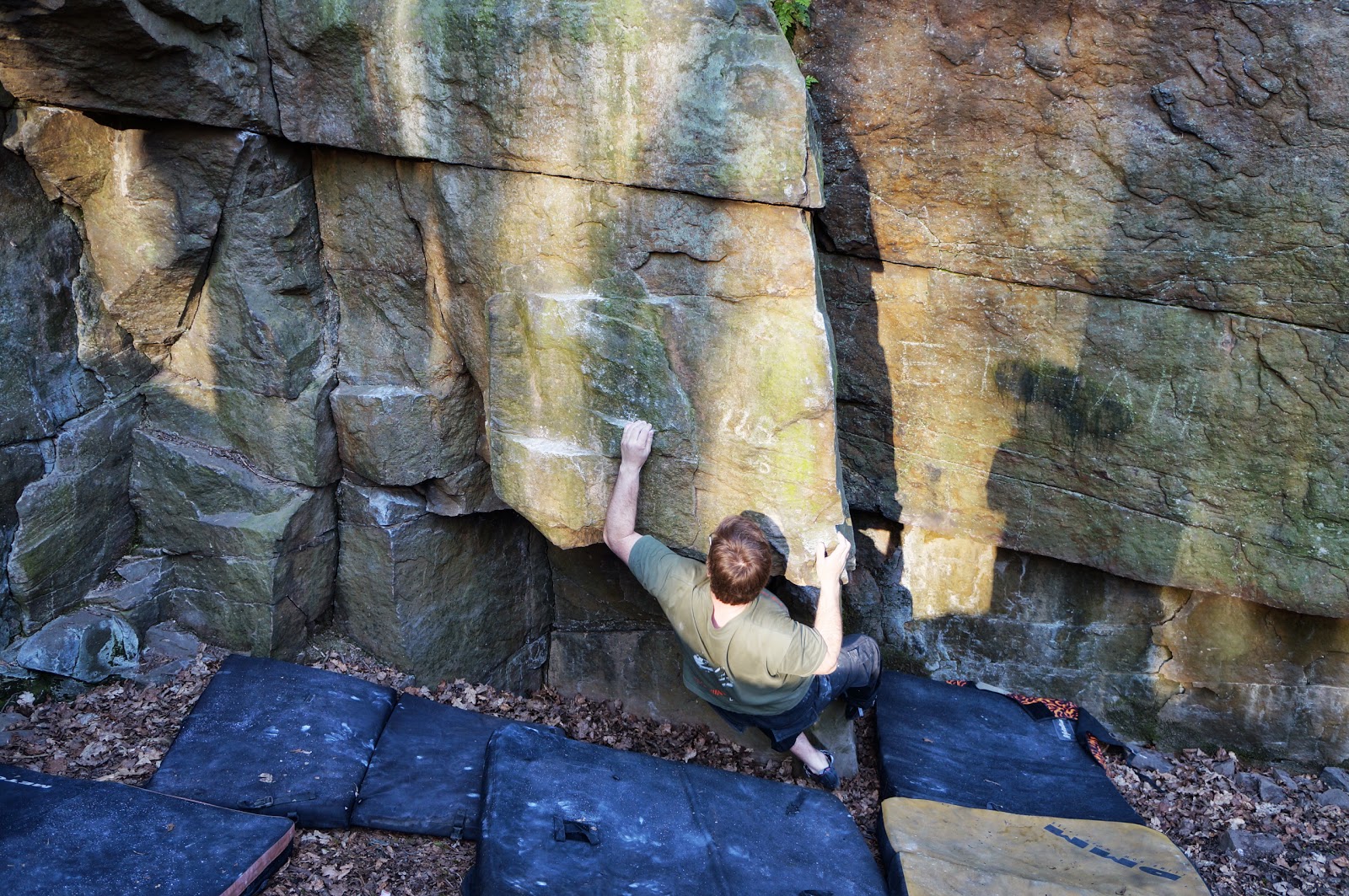
We have been on a quest.  We have purged ourselves of the familiar, forsaken the bouldering fleshpots littered with test pieces that can build a reputation or crush an ego with one slip of a foot.  We have journeyed both west and east from our fair, maritime city on the Mersey, followed sedimentary seams through sand and grit in search of something, something so rare that even to speak its name would make it disappear.  Our merry band have forsaken the luxuries of guides, descriptions, cleaned lines and stars and replaced them with a twilight world. The realm we now move through was once created by the hand of man, but is no longer part of his ambition; instead it has been reclaimed by the elements, earth, air, fire and water. The chemistry of nature dominates these spaces. Holes cut deep in the ground by the desires of industry- now kingdoms of moss and mud.  Lichens keep watch over these rippled quarried walls, and keep us from what we seek.


The Heath, Runcorn
We are not alone in these forgotten spaces, we share them with spectral beings, the youth that loom large in the twilight gloom.  Disenfranchised by daylight, diminished by darkness, their rituals and rights of initiation seek to harness the elements for their own fulfilment   They leap from the quarry walls during the summer months, draw power from the air and are reborn in the watery depths below- emboldened, indestructible heroes of a generation taught not to care.  Fire is the element prized above all else, it illuminates their lives, and destroys our desires with effortless ease!  The blackened, brittle walls demonstrate that we will never be alone - soot and sorrow will always blight our adventures through this twilight world. Our inquisitive eyes scan these walls in the hope we will find that rarefied thing that we seek, more often than not lamenting what could have been.

Andy Jones demonstrating Fatneck's finest creation 
What do we seek?  What could be so precious that it leads grown men to the margins, to a dappled world filled with broken glass and beings decorated with three stripes.  Like Ancient alchemists we seek perfection amongst the elemental forces, our spiritual and physical journey is one of discovery, to unearth the impossible: new amongst the old, quality in crap, first ascents in the subtextural landscapes created by a guide just written. The Alchemists attempted to turn base metals into the perfect, precious metals of gold and silver; in the same way we have attempted to find the aesthetic amongst the ugly, sport amongst the solidified silts.  Our dialectical journey has had us tread a knife edge, teetering along the margins of good and evil.  Some say you cannot polish a turd, it will simply smear in your hands, others know that a carbon rich material subjected to the intense forces of heat and pressure can create diamonds.   The proto chemists of the past did not achieve their aim of a life everlasting, or the extraordinary transformation of mundane materials, could we, however, discover a diamond in the rough??

Alec the Alchemist climbing the Arete that now bares his name (V7 sds V8)
Parbold and Runcorn both sport quarried hills that entertain the shady and the shy, shielding them  from the the glare of society.  Both quarries have built towns, neither have built reputations that might lure the boulderer to their muddied walls and yet, magnetised by their mystery, we have been drawn like moths by their shadowy light.  We have poured scorn on what they have offered, rock has turned to dust by the action of our eager limbs, our desires have been smeared by disappointment, and yet our quest continued, redoubled and intensified until out of the sand,lichen and slime gems began to crystallise and gleam in the gloom. One amongst us has taken on the the mantle of creator he has brought to life lines of movement that transcend what surrounds them.  He has turned the base elements of nature into something that will live on in the future pages of guides and the limitless landscapes of the information age.  For now he is the alchemist.

Jay Dog crimping hard on the Heath.
So our journey seemed to have come to an end.  Some have been bruised, battered by the experience. Blood has been shed and the twilight worlds through which we tiptoed have been tamed, claimed back for now from those who seek to destroy it through ignorance.  However it is naïve to think that we can ever stop travelling on this journey of discovery- the achievements of The Alchemist are just a way marker in the sandstone pointing to what can be created  through the intense scrutiny of our finite local resources.  A message from the man who looked like Marx and answers to the name 'Pop' has shown us the way to what comes next.  There is still sandstone in the suburbs, there are still gems to be found, we all have the ability to turn lead into gold, we can all be Alchemists if we journey long enough along the sedimentary seam of our desires.
 
Portrait of a punter!!
 

Monday, 13 May 2013

Lists and That.

There is some bouldering in those hills.
Lists and order seem to be an integral part of the western cultural cannon. We crave order. Categories are created and the intangible is indexed in an attempt to understand the fuzzy complexity of a reality that constantly evolves around us. This process of comparmentalising the unquantifiable seems to be a necesssary action, something we do to passify ourselves so that we may get on with our lives. Many groups round the world use different devices to do this: mysticism, myth and even magic, our obsession with 'measurement' to map reality robs us of the wonder of looking at the world in different ways. There is a large part of me that feels this is a shame, but then again befuddlement is my default state.

Lists play an important role in Bouldering: tick lists in guides, lists of personal projects, lists of grades and grading systems, lists of problems completed so far this season etc etc. Lists give climbing a faint wiff of competitive conformity; grades and the aroma of quantification open the door to the influence of Sports Science, training regimes, resistance, reps and rests. It's an intoxicating scent; one that promotes motivation, knuckling down and progress. Steps up the ladder of your grading system of choice can be hastened by applying a little logic. There's no magic here, the equation is simple:

                                 Perspiration = Gratification (if grade-based progress is what you seek)
                                                                           Time

Lists have played an important role in my efforts to scratch a path up steeper and steeper sweeps of rock over the years. Lists have informed my training. Wish lists have been written and re-written in an attempt to motivate; lists of desert island climbs or boulders I would like to have in my garden have been seriously discussed, at length, deep into the early hours, thus rendering the chance of climbing a problem that features on a list in the cold morning light next to impossible.  Lists have also been used to entertain.  My favourite climbing lists were the ones that Showtime Farley would create on the twilight drives back from The Peak in autumns past.  On these long drives the excitement of the day would fade to browns, oranges and yellows as our overworked adrenal glands stemmed their flow, the car's collective blood sugar bottomed out and strange shadows were cast by Tom "Fat-hand" Sugden lolling deep in slumber, held up by the tension of his seatbelt alone.  A hush would descend despite the million decibels of bass shaking  the fatigued bones of those incarcerated in the car. At this point Ben would banish the twilight chill of early winter by demanding the 'Best' from us all: best problem, best move, best hold.  Excitment, enthusiasm, and in Tom's case basic motor functions, would return.  In the pantheon of climbing lists, "Best" lists are definitely the best.

Why does climbing seem better when there's snow on the horizon
How can we quantify 'best'?  Well that's the beauty of the concept, you can't, it's just something you like the most at a fixed point we will call 'now'. As the sands of time inevitably shift it will change to something completely different.  Just like the grading systems we use to measure our progress in climbing, 'best' is subjectively constructed around the experience of the individual.  I can't really tell what 'best' is in the same way I can't definitively define what 7b+ is. What I can do though is tell you what my 'bests' have been so far this year: best problem, best move, best venue, best area.  Yes this is a futile exercise and yes these 'bests' will probably change as soon as I experience something else, however, as proved by Showtime Farley in the car on the way back from a kaleidoscope of venues, best lists are a good game. Best gets the adrenalin flowing, Best enlivens leaden limbs and injects colour into the climbing experience washed out by seemingly endless, wet winter.  So let's play Best, get your answers ready, and be ready to shout at mine.

Best Move - above Pwllglass near Ruthin sits Butterfly Buttress.  The steep front-face of this crag is adorned with a myriad of positive holds that make this an ideal link-up venue.  One link moves from left to right through the steepness, it's called "Lead Rain" and my best move sits halfway along its sinuous path.  The move involves kicking up a high heel onto a shelf in front of you allowing you to bump from a tiny hold to a thank-god sidepull.  This slight of heel gets you through the steepest part of the problem efficiently saving energy for the brutal moves ahead.

Best Problem - I had been to Rhiw Coch before and done a circuit of easy problems.  I had a look at Poppy's Move and the other problems in that particular cluster and discounted them as being too hard for my skinny arms. I went back this year with the test pages of the new North Wales Bouldering Guide, and I noticed the problem Moria. A 7b with two stars, I gave it a go and the rewards were exponentially greater than the grade given to the problem.  The line may not be the most asthetic but the moves are stellar- you just can't quantify this quality; go try this problem it really is magic.

Moria in all of its glory
Best Venue - seriously just go with this one.  My best venue so far this year is Pex Hill!!  Yes this hole in the ground, steeped in dog muck and decorated with broken glass is my favourite venue at the moment.  Climbing here this winter, doing eliminates on Pisa Wall, writing about them and spreading the love has saved my climbing from the monotony of training and the inevitable injuries that being serious and scientific brings.  I have visited Pex a lot this year and every time I have left with a smile on my face; if we could grade enjoyment Pex for me would be cutting-edge.

Best Area - without doubt it's North Wales. Words can not capture the feeling of moving across rough, dolerite slopers with a chill in the air and a dusting of snow on the mountains. It feels such a privilege to be climbing in this environment when the conditions are good and the sky is powder blue. When you're high up on the pass, away from the sound of the traffic, looking across at Dinas Cromlech, clouds casting shadows on the valley bottom as they drift lazily by, you feel like you're sitting in an alternate reality, a simpler one, one that makes sense, one that's almost - well mystical.

Moves like these help to generate Bests for everyones lists.
Well there's my Bests, how did yours measure up?  We could negotiate our various Bests, and come  up with a consensus. We could make our Bests definitive, fix them in time and share them with others! To be honest what would be the point, we would simply kill fun.  Sometimes it is better to relax, sit back and enjoy the randomness of things.  I have no idea why I chose Moria as my favourite problem of the year, or why I think Bouldering is better when framed by snowy mountains.  I do know that in a culture obsessed with quantification, and a sport that is quickly being seduced by science, that the game of Bests doesn't really have a place.  For me though that's the point; we should stop trying to quantify fun- let the game of Bests take over, let excitement and enthusiasm flood into climbing. Have your best-ever training session, campus because it puts a smile on your face, give into the magic, get out there and experience more! I reckon that would probably be best for everyone.


Saturday, 4 May 2013

Pex Problem of the Week #8

All good things come to an end and this is the last Pex Problem of the Week.  The purpose of this series was to motivate people, get them out and on rock; particularly at a time of year when most people feel that the coffee and cosy confines of the indoor wall is the only option.  I was hoping to show the utility of eliminate bouldering in terms of training and to open eyes in terms of the quality that Pisa Wall has to offer.  Pisa is dry most of the time and the motivated can use it to get stong at any time of the year.  However there are limits: the sun is shining, the birds are singing, other venues are dry and realistically speaking, those skills and strengths built up on the slopey, scalloped holds of Pisa Wall need to be exploited elsewhere.  The key to progression as a boulderer is variety; go out try every rock type, visit every venue- come back to Pisa in the winter, try the problems again and see how far you have come.

Vitalite Lighter - V7.

This problem may have less holds than it parent but, believe me, it's not lacking in flavour.  This is a robust little number that needs all its ingredients sklillfully combined for its true essence to be savoured.  This really is a case of less is more, and we're not just talking about grades here. Remember you will need the Cheshire and Merseyside Sandstone Guide- go to pages 178 and 179. Right start matched on hold three, place your right foot in a low pock mark, put your left foot high on hold 1.  Flick your left to hold 16, as you move up you will need to dip your right shoulder and this will help you transfer weight through the three finger stack that should now desperately cling to the grains on the surface of hold 16's slopeyness.- you will now need to flag left with the right foot, thus allowing 16 to be locked and the right hand moved to hold 21. So far so good, just like Vitalite, you've been here before, or have you?  At this point things change; you will need to lean back so far it almost feels like your sitting down, milk those stacks for all they are worth, when in balance swap feet on hold 1, get your left foot into hold 6, set it square to the wall. Rock over, and over and over, rock a long way, at the last moment pop to the break and match. Jump off and plan where next week's trip will be.  If you have been following "Pex Problem of the Week" you've trained effectivly for the greater ranges of Frodsham, Helsby and  Parbold! Go on, get out there and conquer them!


Vitalite Lighter from Owen McShane on Vimeo.

Saturday, 20 April 2013

Pex Problem of the Week #7.

This week's problem strips the climbing experience down to its bare bones- its essence! This problem is very much like a three chord Ramones tune: clean, efficient, minimal, in your face, aggressive and purposeful. If climbing could be boiled down, reduced to one move, this move is the one I would choose; it is punchy and delicate in equal measure, fustrating when close, amazing when sent. No other problem on Pisa wall demands dynamism of this quality. The Seven foot dyno might be bigger, but this problem is definitly better; it requires the would-be ascentionist to float rather than fly!

The Pex Dyno V7.

I could be minimal in my description of this problem, it is a one move dyno or deadpoint after all,  however this would rob you of the essential beta which drags this problem into the realm of reality. Firstly locate hold 18 - it is a long shallow crimp. The surface of this hold is rather uniform save for a small rough dimple found slightly left of centre, the pad of the index finger on you left hand needs to nestle in this depression. Once orientated, both hands need to crimp hold 18; don't expect to generate a lot of power from your hands on this problem- body position is key. Now that your hands are set, put your left foot in a lowish dimple directly below your hands. The right foot is placed square to the wall on a prominent dimple up and right. Now it is time for flight; movement will be initiated from the left foot, this will swing your centre of gravity up and over your right foot, this allows you to spring off the right foot and float up to the break. Match and enjoy. This move is all about timing; it works like a rock over, it looks like a dyno, but if you get it right, it feels like magic!


Pex Dyno V7 from Owen McShane on Vimeo.

Wednesday, 10 April 2013

Feel the lick of the Leviathan.

There be sea monsters down there at Borth

In Ellsemere Port over Easter bank holiday weekend they have an international sea shanty festival. I found out about it immediately after the event this year. The sense of disappointment I felt at missing this jamboree was crushing. Unbeknownst to the festival organisers I had grown a fisherman's beard and would have walked tall in this world of facial hair and cable-knit jumpers; a wasted opportunity for which a warm chin in cold weather was no real comfort or consolation. The briny, barnacled world of sea shanties fascinates me: old men in canvas coats and flat caps smoking porcelain pipes, creating close harmonies of times under the sail, stars and moon. This subculture still has a faint whiff of piracy about it, not the type that infringes copyright, rather the dastardly variety that reeks of daring deeds and rum. It's odd that Ellsmere holds this festival. Even with its estuarine position and industrial jetties the town seems divorced from the sea, held hostage by the motorway that now bisects it and provides its life blood.

Now that's what I call a sea shanty beard.

Shanties and songs of the sea were used to motivate and coordinate repetitive tasks undertaken by those who lived under the sail. The Chantyman would lead: he would call the line and the crew would echo his words as they heaved the sail or raised the anchor. In this way tales would be told, and the histories of those who existed in the space suspended between sea and soil would take on their own forms. Stories developed their own energy and life, twisting and evolving into fantastical shapes as they voyaged around the globe and through time, propelled by the winds of adventure. The Chantyman called the line with promises of beasts, battles and booty; the young and strong followed his call to the shore and beyond!

Stories of monsters have always drifted across the seas: The Cracken, The Leviathan, sea serpents and giant whales have fuelled the rhythms of the Chantyman. These beasts have poured fear into the hearts of those on both land and sea, their reputations as fierce as the stories that created them. Legends like these draw out the brave, stupid and strong; young men who set out to sea to make a name for themselves, to fight and become immortalised in the words of the Chantyman.

Whilst my stupidity is well known I am neither brave nor strong, if I chant you a line, will you follow my song?

I spend a lot of my time walking the line between sea and soil finding wave-washed gems to ascend. Ogmore, Ysgo and Dinellain have all been plundered  producing tales to motivate others. Songs of slopers and overhangs, barnacles and biceps drift along these shores. Mid Wales has been one of my main muses for some time: Clarach and Borth have both had me echoing their call, hauling me back again and again to see what new tales lie around the corner. 

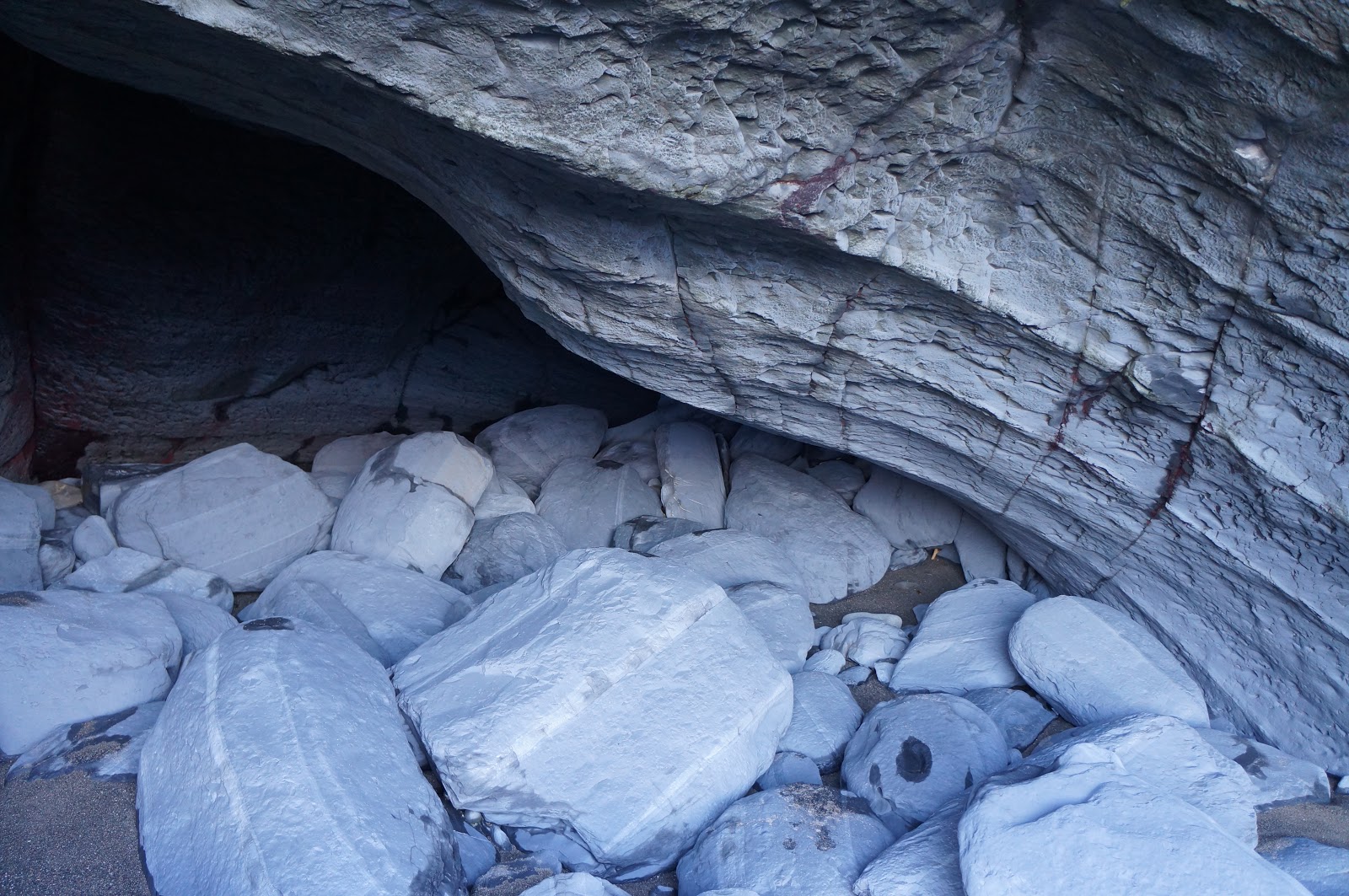
A recent trip across the ancient sands and shales of mid wales revealed a terrifying secret to me, one I will share; what you do with this information is beyond my control. I was trawling the rich coastline at Borth looking for fine, slick slopers of such quality they would drive a boulderer mad. As I assessed the coastline my eyes were drawn to a darkness in the cliff line, something was brooding there in the shadows, something that did not sit well with my conscience. I went to investigate. I did not know what lay there beyond the depths of my perception. What I found filled me with both awe and dread.

The line between sea and soil

On that tranquil shore sits a beast, a leviathan of a line- monstrously steep and fantastically frictionless. Washed up by ancient storms it sits there fossilised by time. I approached this slumbering creature with caution, not wanting to wake it. I gazed upon it smooth yet scaly, barrelled belly scarred by single-pad, directional undercuts leading along its length to a change of angle and some actual holds on its head wall. Tension, strength, patience and persistence would all need to be used in equal measure to tame this animal born in the depths; if we add a less than perfect landing into this equation we are looking at an endeavour that legends are made of! Overcome by fear I turned and ran, knowing that I'm too weak of heart, mind and muscle to go even one round with this beast. I ran knowing that I was lucky to live to tell this tale; this line could consume you, devour your climbing career by placing you in a world of pain with years of fruitless sessions that would strip a man like me of strength, psyche and sanity.

The belly of the beast.


Skinny Dog gives you a sense of the scale, the beast is big!!

You may ask why I chant these lines- who would answer this call? Like an ancient mariner or a tainted trawler man I could just be deluded, lured into fanciful, tall tales by the romance and rhythm of the sea and the ruination of rum. However I have stood beneath many of the titans of Europe: Big Paw, From the Dirt Grows the Flowers, Ill Thrill, Dream Time and the Dagger. Borth's Leviathan could fight them all, go toe to toe, look these other monsters in the eye and know that it belongs in the same storybook. An ascent of the Beast of Borth would be legendary; a hero would be born, a killer line would be tamed and a new story would set sail across the seas creating a life of its own amongst those who toil rhythmically with brush, pad, and chalk.

I plan to go to Ellsmere Port next year at Easter. I want to sit amongst bearded men singing tales of adventure whilst sipping ales and wearing arran. I will listen to Chantymen from around the world painting pictures of a way of life now lost, a life dominated by sail, storms and seas. I would like to chant a song at the festival - tell a tale. My story would reveal a world where sand meets sea, where cliffs and storms collide in a titanic battle that never ends. A battle that creates and destroys in equal measure, a battle from which monsters are born! My story will be filled with a fight between the tides, struggles with slopers, battles with beasts, and the taming of the wild. I will be the Chantyman, will you be the hero?

Friday, 5 April 2013

Pex Problem of the Week #6

Last week we went off-page and explored one of the pisa problems dredged up from the murky mires of my mind. This week our normal service resumes. There are individuals who have been waiting for this week's problem for some time; I make no apologies if I gush slightly in my description as it is one of the best problems I have done anywhere at any time. So turn to pages 178 and 179 of the Cheshire and Merseyside Sandstone guide and we will begin:

Vitalite - V6

Vitalite is the jewel in Pisa's crown; yes there are harder problems and yes it is an eliminate, however climbing with three finger stacks does not get better than this. The quality of movement on this problem means that as an entity it transcends its location, environment, and the circumstances of its creation. If it were pure this problem would have stars- lots of them (and I would still want to give it more)!  Subtle and frustrating, delicate and powerful, Vitalite has it all. This problem deserves special attention; it should stand proud, pure, the only problem on a huge boulder sitting majestically in an unspoilt landscape. Unfortunately Vitalite calls Pex its home but remains undiminished by that fact.

First you will want to go and fetch a brush from your bag, one with very soft bristles that will clean rather than scrape chalk from the surface of this sandstone. Next find holds 16, 21, and 22 (there is no point committing to this endeavour if it is sullied by excess stale chalk- you won't appreciate the true feel of the rock and upward progress will be hard to achieve). Finally, before you begin to climb, step back, breathe in and know that you are about to try one of the best.

Start by matching hold 3, your right foot should be buried in a low pock mark, your left should be high on hold 1 firmly set square to the wall. Now reach up high with the left to hold 16 (to do this you will need to drop your right shoulder to such an extent that it feels like you're looking at the floor). Hold 16 is a very marginal three finger stack, to lock it you will need to take your right foot out of its low resting place, kick it to a deep flag out to the left, find the point of balance and reach with your right to hold 21. Breathe! You should be holding 21 with a stack and it should feel like a gaston (your right elbow should be high), rock up onto your left foot and hit hold 22 as an opposition stack. Squeeze! Swap feet on hold 1, bury your left foot deep into hold six, again with your heel sitting square to the wall start to rock over. At this point you'll appreciate all the cleaning you have done- you've been holding hold 21 for a long time and now you have to shoulder press off it. Press off the right hand, rock onto the left foot until you reach the break. Match, stop, think... Take some time to savour the moment. Jump down, pack up your things and go home, you won't climb anything better this session!


Vitalite V6 from Owen McShane on Vimeo.

Thursday, 28 March 2013

Pex Problem of the Week #5

This week we will deviate from the norm into a world where aspirant ascentionists prowl along the base of Pisa Wall  lobster-like, fingers frozen into three finger stacks ready to claw at the wall. The problem described in this post involves a different species of hold which is also commonly found in this habitat; the small crimp.

Small Snick Sit down V5.

This particular problem does not feature in the Pex eliminate section of the Cheshire and Merseyside Sandstone guide (remember you will need the topo on pages 178 and 179) however, whilst off page, this problem is one of the best! Balance, strong fingers and a bit of technique are needed to breathe life into this (at first glance anyway) unlikely creation.

Start sitting with both hands on hold.number 2. The left foot should be in a pock mark down and left, the right on a clean ripple out to the right.  Pull up off the floor and move your weight over your left foot. Flick the left hand to hold 13 and take it as a gaston and pull the hold into your shoulder. Next put the right foot into a good high pock mark just down and left of hold 2.  Now you're set! Shoulder press off the left hand, rock over onto the right foot, finger press with the right hand to gain height and keep in balance. The right hand needs to get to the mono / small crimp which is hold 38; the only way to get there is to stretch and get over that right foot, the left hand and shoulder need to be strong and they need to press it out.  Once you get your right to hold 38 get the left foot up and left onto a good hold and reach up left to the break. Match and jump off with burning fingertips and well worked lats.


Small Snick sit down start V5 from Owen McShane on Vimeo.